Ribbon Chair
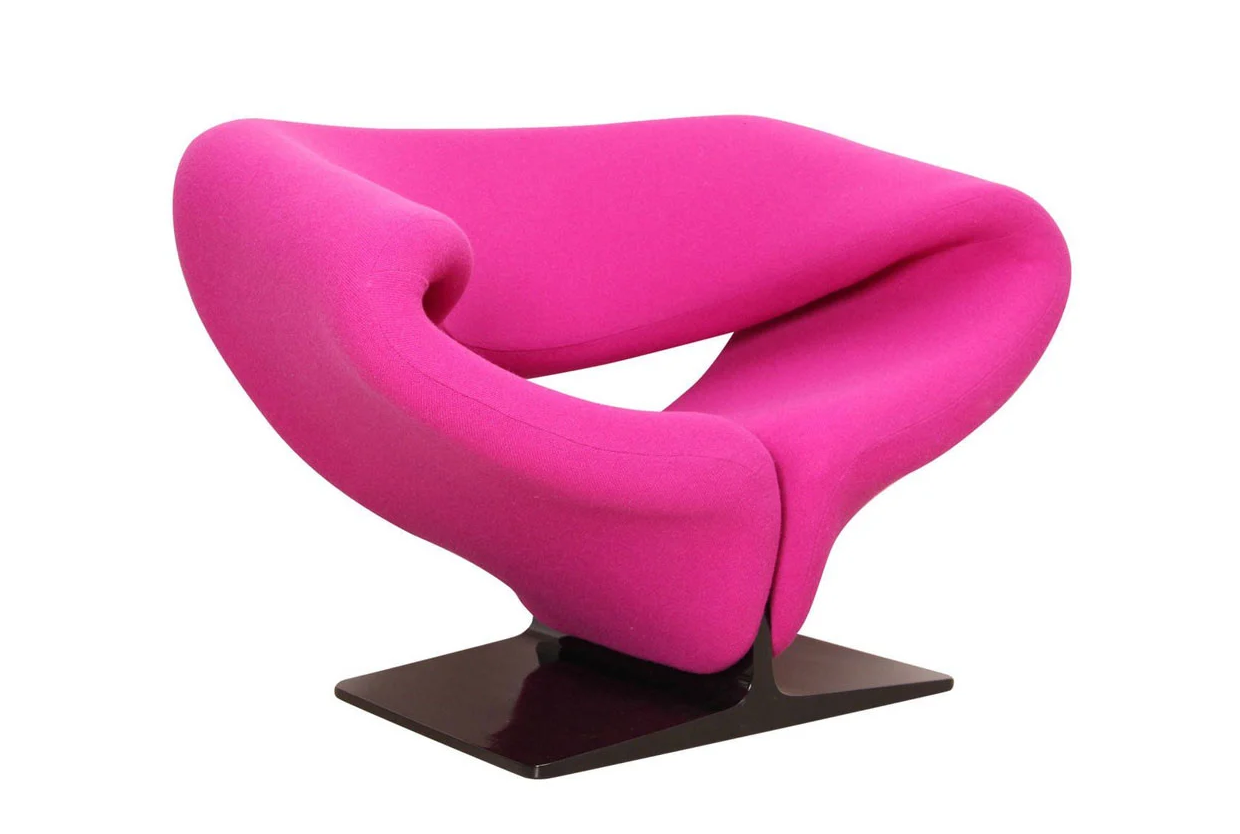
(Pierre Paulin, 1966) The Ribbon Chair by Pierre Paulin is one of those pieces of furniture that seems to have been designed with almost no regard for what a chair was supposed to look like. Designed in 1966 for Artifort, the chair abandons the familiar arrangement of legs, arms, seat, and back in favor of a single continuous form. The result is somewhere between furniture, sculpture, and a piece of Pop Art.
Paulin was part of a generation of designers taking advantage of materials and manufacturing techniques that simply weren't available to furniture makers a few decades earlier. Rather than exposing a timber or steel frame, as designers like Marcel Breuer had done, Paulin concealed the structure beneath foam and stretch fabric. The chair's internal steel frame is almost irrelevant visually. What we see instead is one sweeping upholstered surface.
That surface is what gives the chair its name. From the side, the form appears to fold and curl like a ribbon, creating the seat, back, and arms through a series of continuous curves. There is something almost impossible about it at first glance. The chair looks soft and fluid, yet underneath the upholstery is a carefully engineered structure holding everything in place.
The Ribbon Chair also feels distinctly of its time. By the 1960s, furniture design had moved far beyond the restrained functionalism associated with the early Modernists. Plastics, foam, fiberglass, and synthetic fabrics allowed designers to create increasingly expressive forms. Furniture could suddenly be colorful, playful, and sculptural. Paulin embraced that freedom throughout his career, producing chairs that often looked more like landscapes or objects than conventional furniture.
There is an architectural quality to the Ribbon Chair as well. Instead of assembling separate components, Paulin creates space through one continuous gesture. The chair wraps around its occupant, forming a small enclosure rather than simply providing a surface to sit on. In that sense, it operates almost like a miniature piece of architecture.
Nearly sixty years later, the Ribbon Chair still looks futuristic. Perhaps that is because it belongs to a moment when designers genuinely believed new materials could produce entirely new forms of living. It is comfortable, functional, and undeniably strange.
Most importantly, it proves that even something as familiar as a chair can be completely reconsidered with one simple idea: take a flat ribbon, bend it through space, and see where it leads.