Wassily Chair
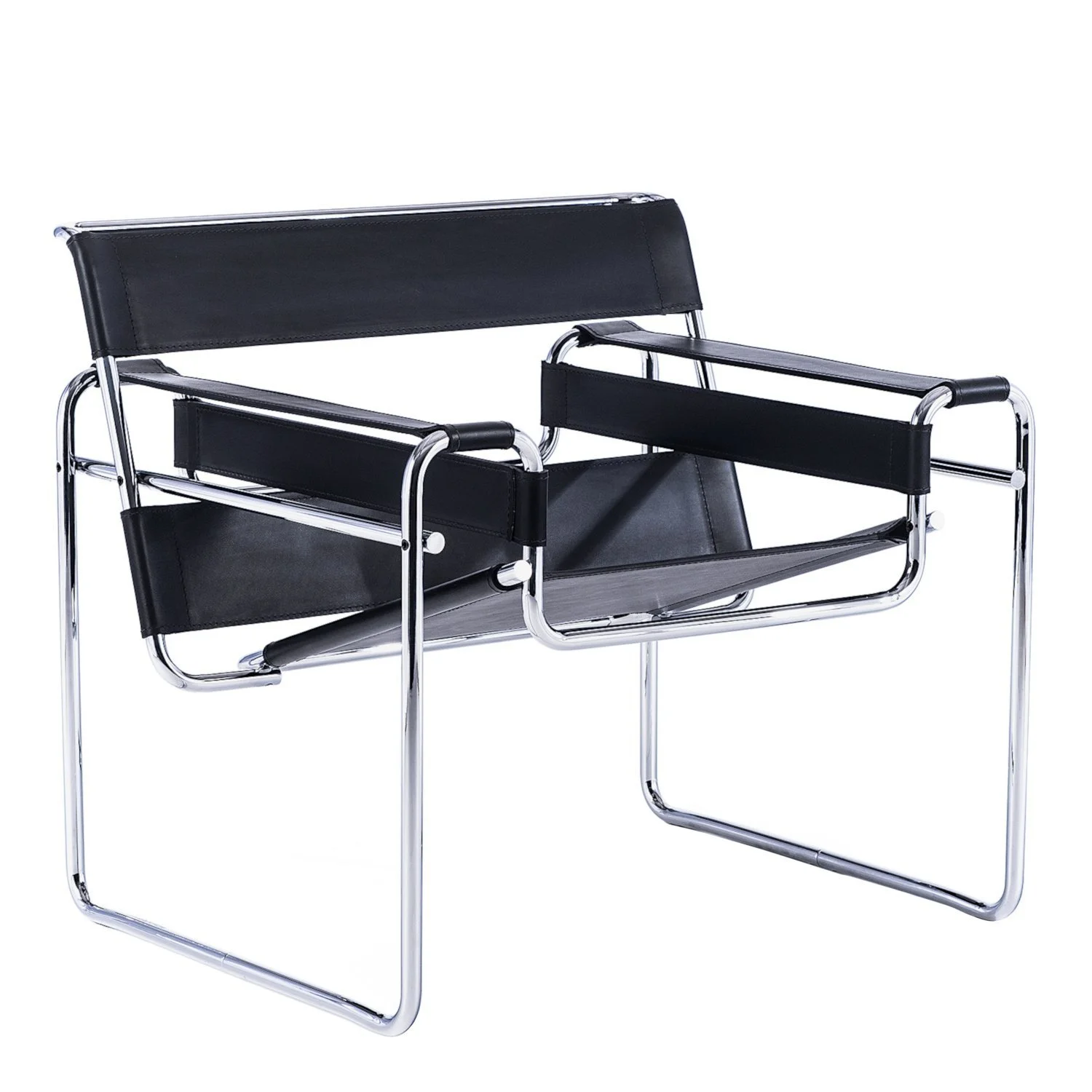
(Marcel Breuer, 1925) There are certain pieces of furniture that feel inseparable from architecture, and Marcel Breuer’s Wassily Chair is one of them. Designed in 1925 while Breuer was working at the Bauhaus in Dessau, the chair looks less like traditional furniture and more like a small piece of engineered structure. Nearly a century later, its tubular steel frame still feels surprisingly modern.
The inspiration famously came from an unlikely place: the bicycle. Breuer was fascinated by the strength and lightness of the tubular steel used in bicycle frames and began experimenting with the same material for furniture. At the time, chairs were still largely constructed from solid wood, so replacing that mass with a thin continuous framework of bent steel was a radical proposition. The chair wasn't carved or assembled from heavy components; it was essentially drawn in space with a metal tube.
The original design was known as the Model B3. The name "Wassily Chair" actually came later, after the painter and fellow Bauhaus professor Wassily Kandinsky admired the design and Breuer produced a version for him. When the chair was reissued decades later, Kandinsky's association became part of its identity, and the nickname stuck.
What makes the chair particularly interesting is how little material is actually required to define it. The tubular frame establishes the overall volume while strips of fabric or leather create only the surfaces necessary to support the body. Everything else is left open. The conventional upholstered armchair has effectively been stripped down until only its structural diagram remains.
That idea feels distinctly architectural. The frame is completely exposed, and there is no attempt to disguise how the chair stands up or how its components work together. Breuer separates structure from enclosure in much the same way Modernist architects were beginning to separate a building's structural frame from its walls. The result is both furniture and an expression of the larger ideas being explored at the Bauhaus.
Today, the Wassily Chair has become such a recognizable design object that it's easy to forget how strange it must have looked in 1925. Chrome tubing eventually became commonplace in furniture, offices, waiting rooms, and countless imitations. But Breuer was working before that visual language had become familiar.
Perhaps that is the chair's greatest legacy. It didn't simply create an iconic form; it demonstrated that an ordinary industrial material could completely change our expectation of what furniture should look like. One hundred years later, the experiment still looks remarkably convincing.